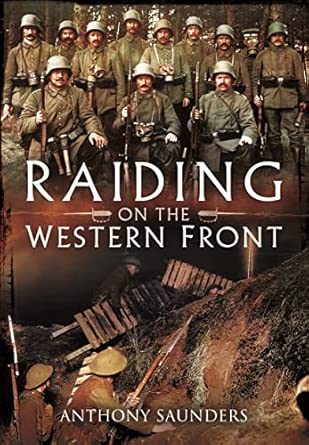
Anthony Saunders’s Raiding on the Western Front is a useful introduction to one of the defining features of trench warfare during the First World War. Saunders argues that trench raiding became emblematic of the aggressive and close-combat nature of warfare on the Western Front, serving not only as a means of gathering intelligence but also as a way of exerting pressure on the enemy and maintaining offensive spirit among friendly troops. He demonstrates that raids could have important psychological effects, boosting morale when successful but damaging it when they failed and incurred casualties for little tangible gain.
One of the book’s principal strengths is its breadth of coverage. Saunders draws upon numerous examples from across the Western Front to illustrate the variety of raiding operations and the bravery, leadership and sacrifice they often involved. The result is a vivid account of a neglected aspect of the war. For readers unfamiliar with the subject, the book provides an accessible overview of how raids were planned and executed.
However, the book is less convincing when it moves from description to analysis. A significant weakness is an apparent contradiction in Saunders’s treatment of success and failure of raids. Early in the book he cautions that: ‘The question of success or failure of a raid, or of raiding as a whole, was and is not a simple equation that can be solved by inserting the appropriate figures to arrive at a definitive answer’ (p.8). He further notes that ‘the criteria concerning success were not necessarily the same for the British, French or Germans’ (p.8). Yet only a few pages later he evaluates raiding performance largely through statistical measures, noting that of 310 British raids during the Somme campaign, ‘204 were reckoned to have been successful’ and concluding that ‘the failure rate was 34 per cent’, compared with a German failure rate of 66 per cent (p.17). While Saunders does raise questions about the interpretation of these figures, the reliance on numerical comparisons appears difficult to reconcile with his earlier warning against reducing success and failure to statistics alone. Neither does he seek to define what success or failure was in his study.
Questions also arise regarding the raiding record of the 1/13 Battalion London Regiment (Kensingtons). Saunders states that ‘it is unclear whether the Kensingtons undertook many other raids, daytime or at night, during the rest of the war’ and that they undertook ‘at least one more raid before the war ended’ (p.76). Yet the book itself goes on to describe two further raids. This suggests that the battalion’s raiding record was not investigated as thoroughly as it might have been. More controversially, Saunders characterises the Kensingtons’ raiding history as something of a ‘farce’, even though they were the most extensive and successful raiding battalion in the 56th Division, carrying out six raids that successfully secured enemy identifications in half, a better record than any other unit in the division. My grandfather served in the Kensingtons so this is personal to me and probably participated in at least one raid.
A further limitation is the book’s structure. Much of the narrative consists of a series of individual episodes and case studies. Although these accounts are often fascinating, Saunders does not always draw them together into a broader explanation of how raiding evolved over the course of the war. The reader is presented with numerous examples but relatively little sustained analysis of changing doctrine, tactics or effectiveness. Consequently, the book sometimes feels more like a collection of illustrative acts than a coherent study of the development of trench raiding.
A final challenge is that the publication is not referenced so it is impossible to check the claims made with the source material which is a major limitation.